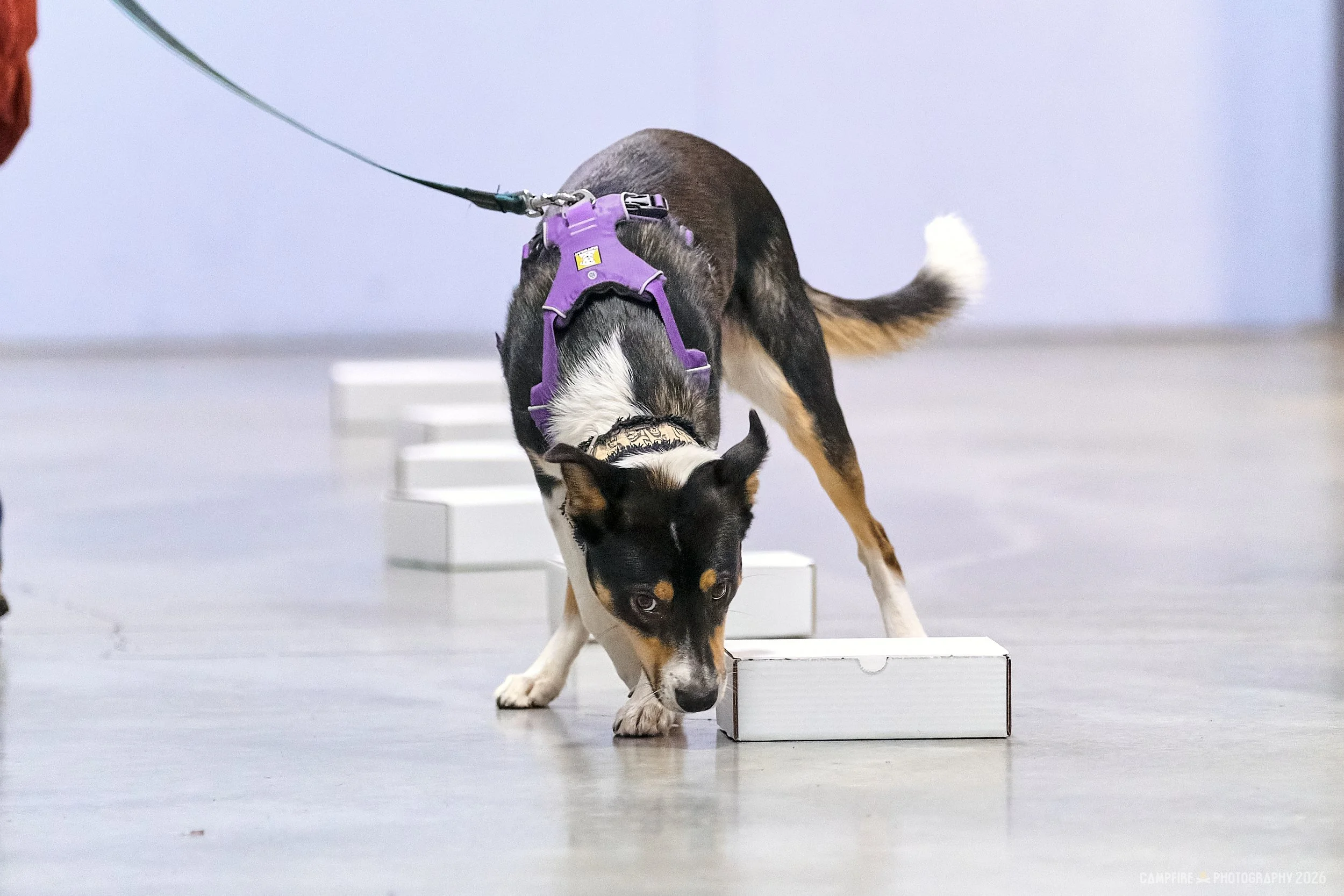
For dogs, especially puppies with fear or confidence issues, it is best to begin nose work with food only, also called primary, before introducing essential oil odor. After a period of food only searching, we move to odor that is paired with food. These steps are prior to moving solely to handler rewarded essential oil odor searching.
This approach has been established for many years by the nose work community and supported by the instructor training/certifying association, the National Association of Canine Scentwork, NACSW.
This approach builds a solid foundation, supports the dog’s motivation to search, and reduces the possibility of linking negative associations with environmental elements in (essential oil) odor searches.
Why starting with food rewards helps
Foundation and certainty: A primary reward gives the dog an instant, clear, reliable payoff. This strengthens the dog’s interest in/excitement about searching and driving all of the way to source.
Safer, slower learning: When learning is built on food, the dog forms only positive associations at his or her manageable pace. Introducing odor too soon can lead to the odor becoming tied to something negative in the young dog’s mind.
The process takes time (YES, LOTS OF TIME), but if done correctly, it yields steadier long-term progress and clarity for both the dog and the handler. I also believe it supports the dog’s trust in the handler, that this particular activity is always a good, happy pursuit to be engaged in!
An additional piece is that handlers also have to learn to reward correctly — that the reward must come quickly as close to source as possible. While this sounds simple, it takes practice to be a reliable human replacement for primary or pairing. This is especially true as dogs become more skilled and searches become more challenging!
Why the progression matters especially for fearful dogs
Fearful dogs face challenging environments and encounters with people. A food only progression helps them build independent confidence as they work through tasks that might feel hard to them, tasks like approaching corners, thresholds, etc. It rewards them at an even pace for overcoming those fears, incrementally, and solidly. Almost any complex odor puzzle that the dog will later encounter with birch/anise/clove, etc., can also, earlier, be created with food alone or with pairing.
If odor is introduced too soon, the dog may later associate the odor or the activity with something that is “dangerous” from the dog’s perspective. This can then show up as an unpredictable progression in training and in trialing.
When this is done correctly
The dog will become more confident and independent, supported by the immediate self-reward of food.
The handler’s patience and consistency lead to more durable, reliable, and ultimately successful search behavior in the dog when they are transitioned to essential oil odor.
